Bookify
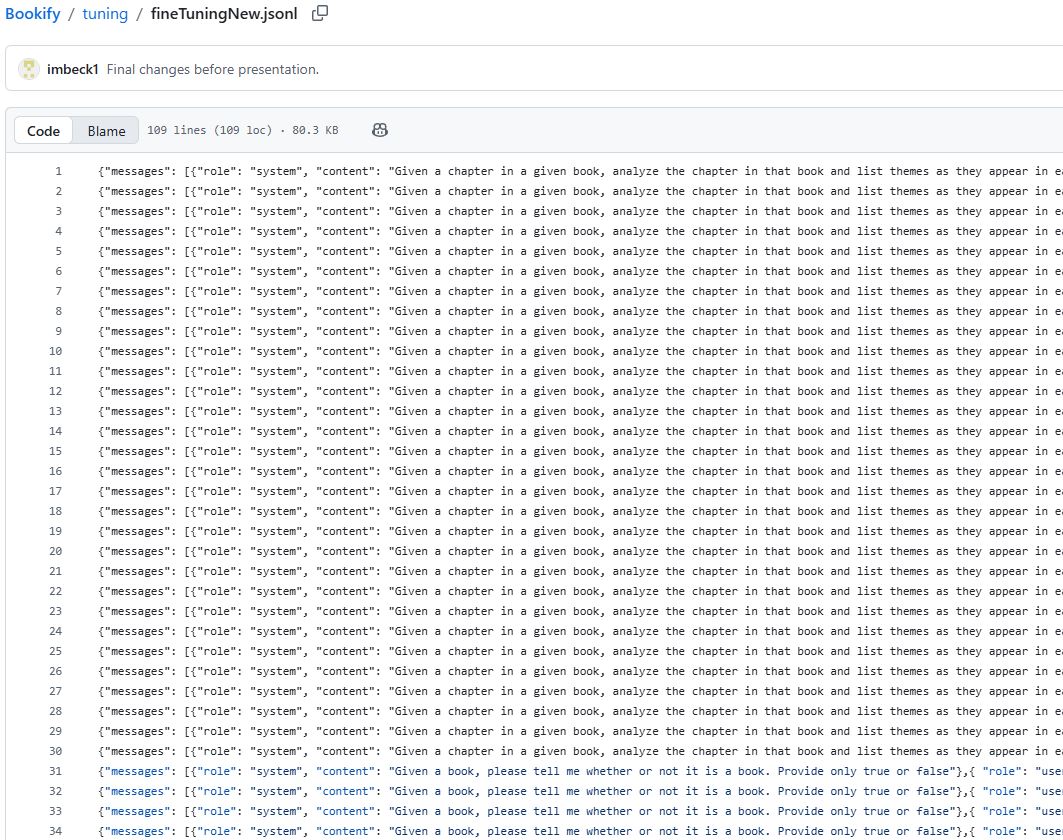
This page showcases features for my Capstone Project for Appalachian State. The title of this project was "Bookify". It was a JavaScript built, AI-powered site that used OpenAI and Spotify web APIs to generate playlists for a user based on their inputted book title. The site was built using HTML CSS, and JavaScript using Node.js to write the functions and to make calls to the APIs. I do not still have the keys for either the Spotify or OpenAI APIs, and have lost my previous reports (due to hard drive corruption) that included screenshots of the running project. Therefore, a link at the bottom of this page will direct to the Github source code for this project.
Front End
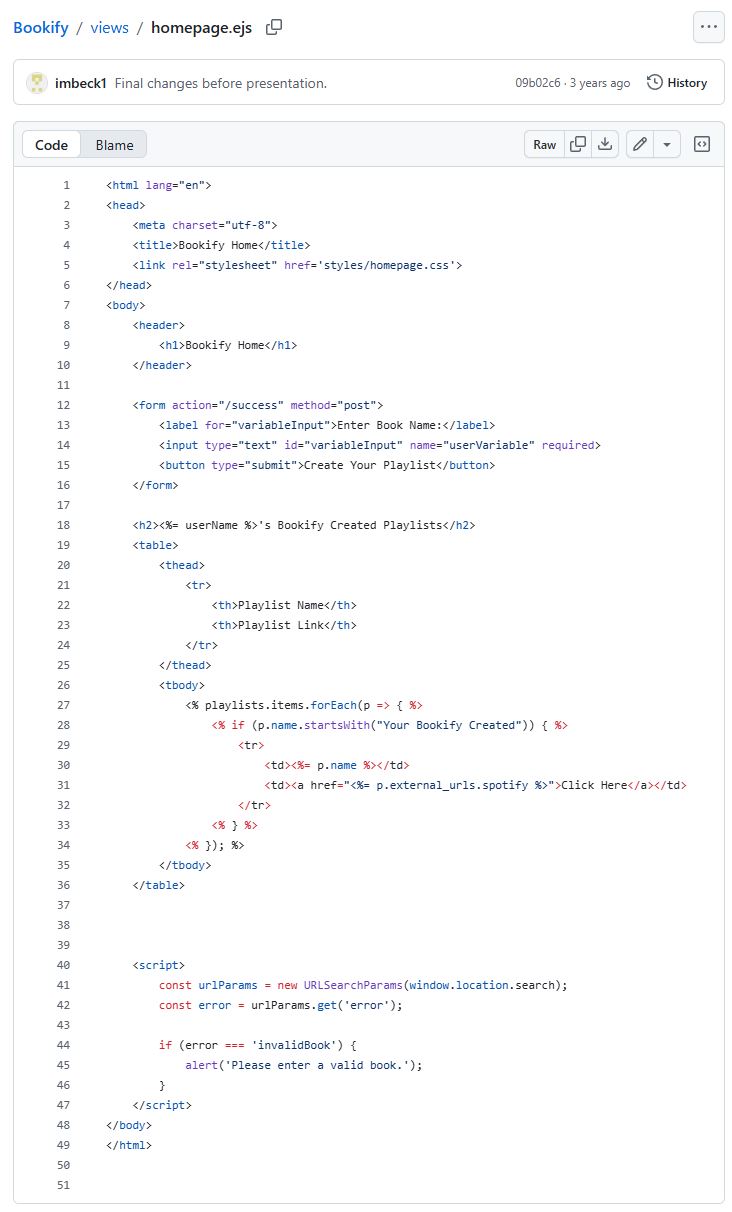
The front end for Bookify was very simple. I used .ejs files for my markup so that DOM features would be more easily implimented with Node.js. My front end consisted of a Login page, a Home page, and a Success page. The Login page was the first one visible when visiting the site. The page made a call to Spotify, allowing a user to login to their Spotify account. Once logged in, the user was then directed to the Home page where they were prompted to enter a book title. Once the user entered a book title, if the title was vaild, the program would create a Spotify playlist for them and direct them to the Success page which contained a link to the user's newly created playlist.
Algorithm
For the analysis of any given book, I used OpenAI's ChatGPT to analyze the book. ChatGPT would first confirm whether the inputted text was or was not a book before continuing with an analysis. Once the book was validated, the AI model would give an estimated average reading time for the given book and then break it into sections. Each section was then analyzed by ChatGPT and assigned themes and tones. Those were then translated into a list of Spotify-compatible genres. Once those genres were generated, the algorithm would make calls to Spotify using the genres to find a song that fit. These songs would generate until the playlist had a duration equal to the determined average reading time for the book. The filled playlist would be immediately available in the user's Spotify library.
Fine Tuning
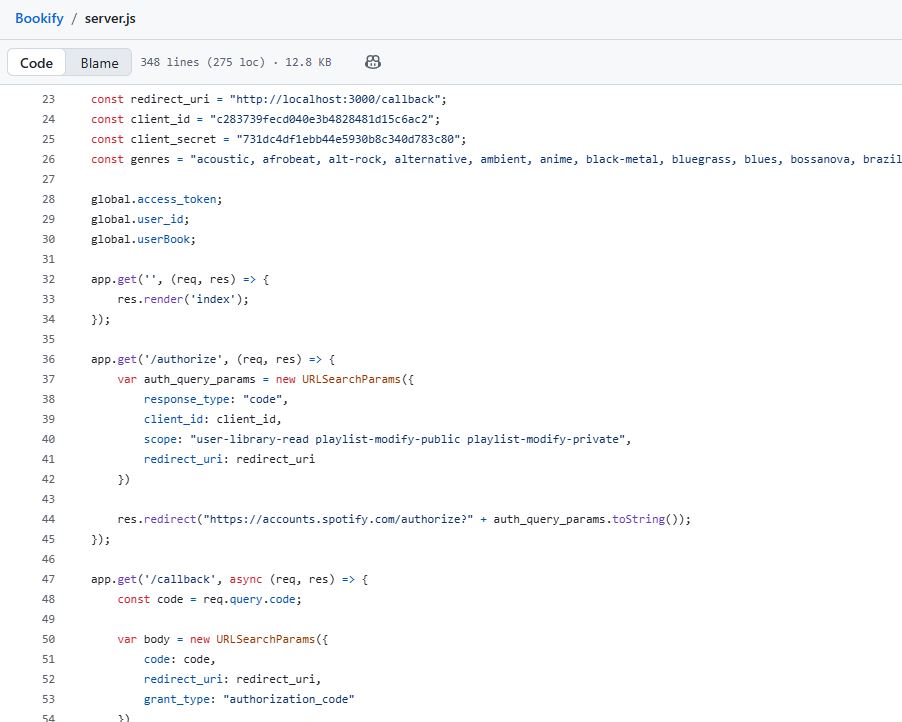
The exactness of variables were very important to my algorithm. Every generated variable had to be precise to work with the rest of the code. At first, I had a lot of trouble keeping my ChatGPT generation consistent. However, before the end of the project I learned about Fine-Tuned models. This feature let me create a personalized version of any ChatGPT model and teach it what input to expect and what output to generate. It took a lot of trial and error to fine-tune my model to work the best with my algorithm. After many attempts, I finally got a model that perfectly fit my needs.